

Ever seen a perfectly tuned orchestra, violins shimmering, drums pounding, flutes singing, but no conductor in sight? Everyone starts playing at once, and the music collapses into chaos.

That’s exactly what happens to modern businesses without API integration. You have dozens of apps, tools, and platforms, each excellent on its own, but none of them communicating.
Now imagine a conductor lifts the baton, and everything syncs. That conductor is your API (Application Programming Interface), the invisible hero behind modern business systems. Every time your CRM updates your sales dashboard, or your inventory system syncs with your e-commerce store, or your payment gateway confirms a transaction instantly, it’s all happening through smart API integration.
APIs are the digital connectors that make technology hum in harmony. Without them, every business process would sound like a noisy rehearsal.
What Exactly Is API Integration?
Let’s simplify it. Think of your business as a big city. Each department, HR, Sales, Operations, Finance, is a neighborhood. APIs are the highways and bridges that let data travel freely between them. Without APIs, everyone would have to send “digital couriers”, manual reports, emails, or spreadsheets. Slow. Clunky. Risky.
With API integration, data flows in real time. Your marketing platform knows when a new lead signs up. Your accounting software updates invoices automatically. Your warehouse system adjusts stock the second a customer places an order.
It’s fast, automated, and effortless, the heart of business automation and digital transformation.
Scenario: When Departments Speak Different Languages
Imagine an office where every team speaks a different language: HR in Hindi, Finance in Tamil, IT in Bengali. Absolute confusion.
Now, introduce a translator who instantly understands and delivers messages perfectly. That’s what an API does. It helps different software systems “talk” to each other, translating complex data formats into clear, understandable information.
An API-driven system ensures your business runs smoothly, and everyone communicates in one digital language.
Secure Integration & Compliance: The Trust Factor
In the world of data integration, speed is important, but security is everything. API integration isn’t just about connecting systems; it’s about connecting them safely.
Every API exchanges sensitive data, customer names, payments, analytics, even personal details. So, you must prioritize secure data transfer and privacy compliance.
Here’s where smart businesses rely on a Privacy Policy Generator. It helps create customized, legally sound privacy policies that explain how your API systems handle data securely.
By embedding transparent privacy policies into your integration strategy, you assure customers that your systems are both connected and compliant, which builds trust and boosts your brand reputation.
In today’s market, data security isn’t optional; it’s your strongest competitive advantage.
Authentication & API Security: Locking the Digital Doors
Would you leave your house unlocked just because your neighborhood feels safe?
Of course not.
APIs are entry points to your data, and they must be locked tight. That’s where authentication and credential management come in.
Every developer knows the importance of using strong API keys and access tokens, but those only work if your credentials are actually strong. Using a Strong Password Generator ensures that every password or token you create is complex, unique, and unbreakable.
It’s your digital lock, keeping cybercriminals out and protecting your business’s backbone.
When implementing API security best practices, focus on:
- Token-based authentication (OAuth, JWT)
- Data encryption (SSL/TLS)
- Access control and role-based permissions
- Password rotation and management
This is what transforms an ordinary integration into a secure, enterprise-grade ecosystem.
The Chain Reaction of Efficiency: How APIs Transform Workflows
Once your APIs are connected and secure, business operations start to flow like clockwork.
A customer places an order → inventory updates → logistics gets notified → payment confirms → analytics capture sales data, all happening in seconds.
That’s not magic. That’s API automation.
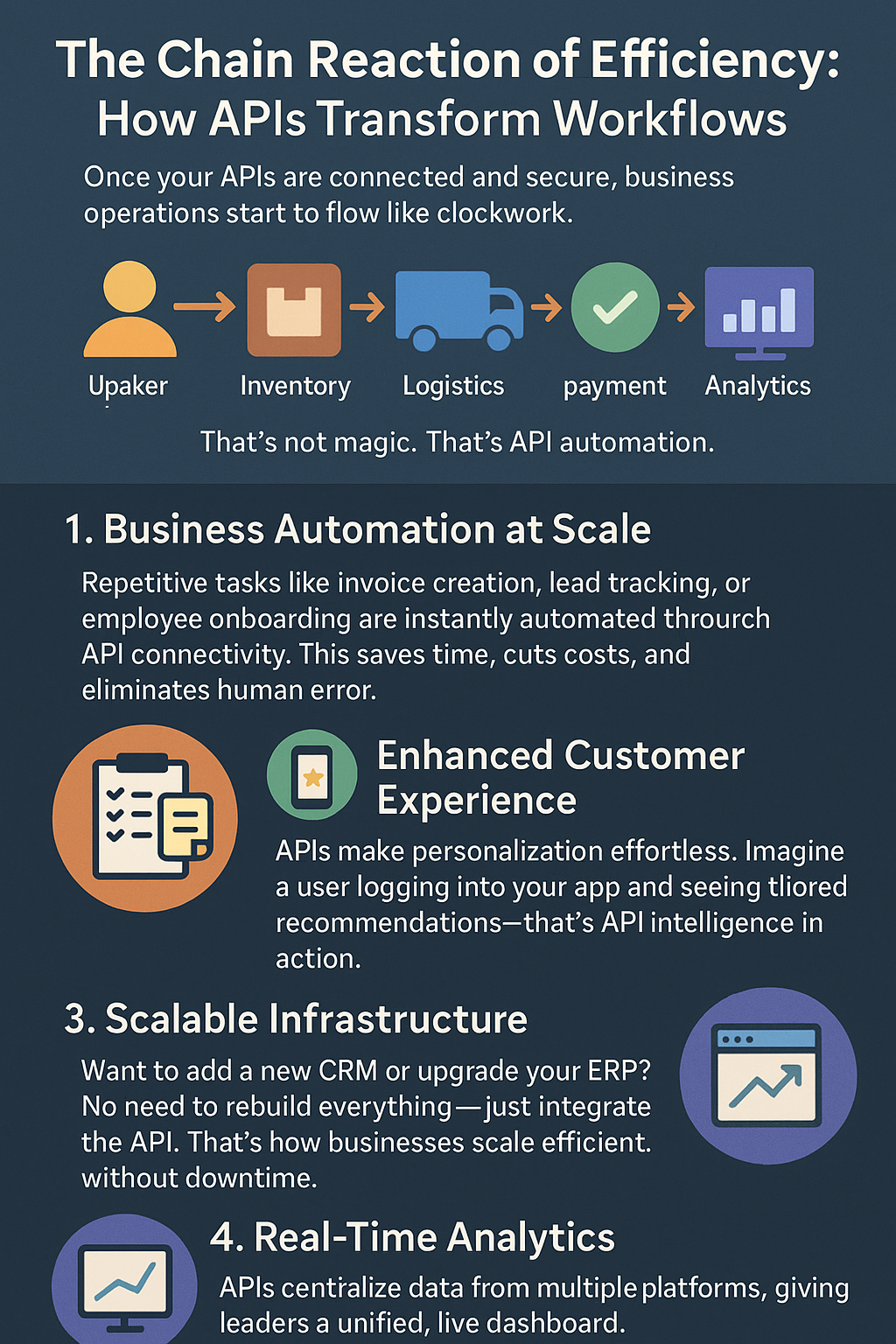
1. Business Automation at Scale
Repetitive tasks like invoice creation, lead tracking, or employee onboarding are instantly automated through API connectivity. This saves time, cuts costs, and eliminates human error.
2. Enhanced Customer Experience
APIs make personalization effortless. Imagine a user logging into your app and seeing tailored recommendations, that’s API intelligence in action.
3. Scalable Infrastructure
Want to add a new CRM or upgrade your ERP? No need to rebuild everything, just integrate the API. That’s how businesses scale efficiently without downtime.
4. Real-Time Analytics
APIs centralize data from multiple platforms, giving leaders a unified, live dashboard. Real-time insights → smarter decisions → better growth.
That’s the true rhythm of digital transformation.
Developer Testing: The API Sandbox Playground
Before an API goes live, developers need to test integrations in a safe environment, like a pilot in a flight simulator. This is called a sandbox environment, and it’s essential for catching bugs before customers do.
During testing, developers often need disposable email addresses to verify notifications, user logins, or authentication flows. Using real company emails can create privacy risks or clutter inboxes.
Enter Temp Mail, a safe, secure, and easy way to create temporary emails for API testing. It’s perfect for testing email-based API workflows without exposing real data.
Anchor: “developer testing email workflows” → link to Temp-Maill.org.
With tools like these, developers can simulate real-world API scenarios without compromising security or data integrity.
Embedding Security into Every Layer
The best companies treat API security as a culture, not a checklist.
- Design with Security First: Plan authentication and encryption before writing code.
- Test in Sandbox Mode: Use tools like Temp-Maill.org for risk-free testing.
- Document Everything: Clarity reduces misconfigurations.
- Comply Transparently: Generate privacy policies using Privacy Policy Generator.
- Authenticate Strongly: Rotate passwords and use the Strong Password Generator.
When your system treats security as a reflex, not an afterthought, customers feel it. They sense your brand’s reliability.
Real-World Applications: How APIs Power Industries
Manufacturing & Industrial Integration
At Tigapilar Mandiri, API integration connects production data, performance monitoring systems, and predictive maintenance dashboards. Machines “talk” to servers, identifying issues before they happen. That’s smart manufacturing automation in motion.
E-Commerce & Retail
In e-commerce, APIs connect payment gateways, inventory systems, and delivery tracking apps, creating that frictionless experience customers love. It’s the foundation of modern omnichannel retail.
Finance & Banking
APIs drive instant payments, fraud detection, and KYC verification. Every time your UPI app flashes “Payment Successful,” thank an API.
Healthcare & Wellness
APIs allow secure patient data exchange between clinics, labs, and insurance systems. It’s efficient, accurate, and compliant, proving that even sensitive industries can innovate safely.
Benefits of a Strong API Ecosystem
- Real-time data synchronization across teams
- Automated workflows that reduce manual work
- Faster time-to-market for new digital products
- Enhanced data accuracy and visibility
- Reduced operational costs
- Customer loyalty through seamless service
- Improved compliance with privacy and legal standards
Each of these benefits compounds over time, making your business leaner, faster, and more adaptable.
Challenges (and Smart Fixes) in API Integration
| Challenge | Solution |
| Data inconsistency | Standardize with JSON or XML formats |
| Security risks | Use SSL/TLS, authentication tokens, and a Strong Password Generator |
| Compliance gaps | Generate clear privacy statements with Privacy Policy Generator |
| Testing failures | Use sandbox APIs and Temp-Maill.org for safe trials |
| High maintenance | Automate updates with API management tools |
Challenges are inevitable, but strategic integration makes them manageable.
Best Practices for Long-Term Success
- Document every API endpoint.
- Encrypt all data in transit and at rest.
- Monitor API usage with analytics tools.
- Rotate access keys and credentials often.
- Stay compliant using privacy policy templates from Privacy Policy Generator.
- Encourage developer testing with Temp-Maill.org to prevent leaks.
- Design APIs for scalability.
These practices turn basic integrations into enterprise-grade digital ecosystems.
The Future: AI, Automation, and API-First Design
The future of API integration is intelligent. As AI-powered APIs and low-code integration platforms rise, businesses will shift toward API-first architectures, designing every new system with integration in mind.
In this future, speed, security, and interoperability will define success. And the companies that understand how to connect systems smartly will always stay ahead.